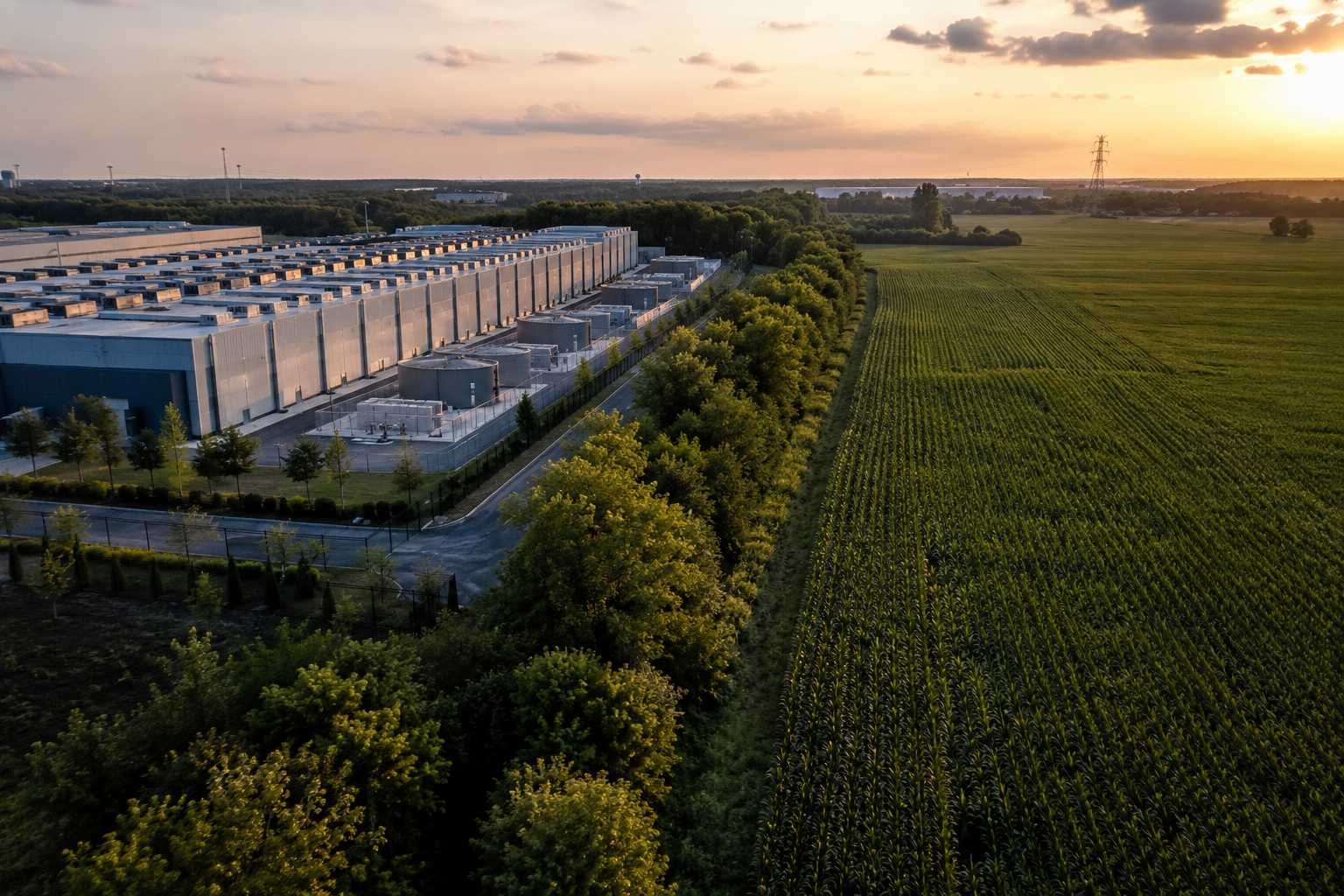
Artificial intelligence may turn out to be one of the most important technological revolutions of our lifetime. It can improve medicine, speed up research, automate repetitive work, strengthen cybersecurity, help small businesses compete, and give people back the time they used to lose to a screen.
But the way we are building the physical infrastructure behind AI should concern everyone.
As someone who has spent more than two decades in hosting and infrastructure, I see the excitement. I also see the physical limits.
Behind every chatbot, image generator, code assistant, medical model, and automation platform is an enormous physical machine: the data center. These are not magical clouds floating above us. They are buildings. They need land, power, cooling, and, in many cases, water. They need transmission lines, substations, backup systems, fiber, access roads, generators, batteries, and people to maintain them.
AI may be digital, but its footprint is very physical.
Right now, the world’s wealthiest companies and some of the smartest people in technology are racing to build massive AI data centers as fast as possible. The urgency makes sense. Demand is exploding, and whoever controls the compute controls a large part of the AI economy. But speed without wisdom is not innovation. It is speculation with concrete, steel, copper, water, and farmland.
We are watching a gold rush, and like most gold rushes, the people closest to the excitement assume the boom will last forever.
It will not.
The Coming AI Infrastructure Fatigue
At some point, AI infrastructure will hit an efficiency wall. Not because AI disappears, but because wasteful AI gets too expensive.
Models will get more efficient. Chips will improve. Cooling will improve. More AI will run closer to the device. Smaller specialized models will replace oversized general-purpose models for many tasks. Businesses will realize they do not need a trillion-parameter model to answer a support question, write a product description, audit a log file, or summarize a document.
When that shift happens, the industry will start separating useful infrastructure from overbuilt infrastructure. Some facilities will stay valuable because they are well located, power-efficient, water-conscious, and adaptable. Others will become monuments to panic building: huge structures in the wrong places, dependent on strained grids, built with little regard for local communities or long-term efficiency.
The real risk is not that every data center becomes useless. The risk is that many of today’s projects are designed around today’s hardware assumptions, today’s hype, and today’s fear of missing out.
That is not planning. That is reacting.
This Is Not Just a Technology Problem
A data center is not just a building full of servers. It is an energy project. It is a land-use decision. It is a water decision. It is a grid-planning decision. It is a local economic and environmental decision.
Yet communities are often asked to approve these projects as if they were ordinary commercial developments.
They are not. A warehouse adds truck traffic. A factory adds jobs and emissions. A hyperscale AI data center can pull enormous amounts of electricity around the clock, force major grid upgrades, create noise concerns, and use significant water depending on the cooling design.
When a private company profits from the compute but the local community absorbs the higher utility pressure, the land loss, the noise, the water stress, and the grid upgrades, that is not free enterprise in its purest form. That is cost-shifting. Free enterprise should reward innovation. It should not give companies permission to push the consequences of poor planning onto everyone else.
The Apple Lesson: Efficiency Is the Real Innovation
The AI industry should study one of the most important technology lessons of the last two decades: Apple’s move away from Intel.
For years, Apple wanted more performance with less heat and lower power draw. Intel could not deliver it at the pace Apple needed. So Apple did what great companies do when the market cannot meet their standards. It built the solution itself.
Apple Silicon was not just a chip decision. It was an efficiency decision. Apple redesigned around the experience it wanted: better performance per watt, longer battery life, less heat, tighter integration, and a product that simply felt better to use.
That same mindset is what AI infrastructure needs.
The question should not be how many more massive data centers we can build. The question should be how much more useful intelligence we can deliver per watt, per gallon, per acre, and per dollar.
That is the real benchmark.
If a vendor cannot deliver the efficiency you need, find another vendor. If the cooling system wastes water, redesign it. If the grid cannot support the facility without raising costs for locals, the project is not ready. If the site eats productive farmland when non-agricultural land is available, the plan is flawed. Sometimes innovation does not come from Goliath. Sometimes it comes from David, because David is forced to be smarter.
Farmland Should Not Be the Default Sacrifice
One of the most troubling parts of this boom is how casually land gets treated.
Farmland is not empty land. It is productive land. It is food security, open space, and part of a region’s identity, economy, and environmental balance. Once farmland becomes industrial-scale development, it rarely goes back.
Data centers should be steered toward land that is already industrial, underused, contaminated, or otherwise unsuitable for farming and sensitive habitats. Governments should not let prime farmland become an easy target just because it is flat, available, and close to power lines. Land-use policy needs to catch up with the scale of this infrastructure.
A responsible project should answer some basic questions before approval:
- Can it avoid productive farmland and sensitive wildlife areas?
- Can it operate without stressing local water supplies?
- Can it generate or contract truly additional clean power?
- Can it avoid raising electricity costs for residents?
- Can it keep noise to a level that nearby communities can live with?
- Can it reuse heat, or at least reject heat efficiently?
- Can it be repurposed if AI demand changes?
- Can it prove its environmental claims are real and not accounting tricks?
If the answer is no, the project should not be rubber-stamped.
The Standard Should Be Self-Sufficient, Low-Impact Infrastructure
The next generation of AI data centers should be held to a higher bar. The ideal facility should come as close to being self-sufficient as possible. It should generate or directly support its own clean electricity, use little to no potable water for cooling, sit on land that does not displace farming or damage ecosystems, stay quiet, and be designed for heat efficiency, hardware replacement, grid flexibility, and eventual reuse.
It should not just consume the local grid. It should support it. A modern facility should be able to reduce load during grid stress, store energy, take part in demand-response programs, and line workloads up with periods of clean power. Training jobs that are not time-sensitive can be scheduled intelligently. Not every workload needs to run at peak demand on a strained grid.
This is where AI can help solve its own problem. Use it to optimize cooling, predict maintenance, shift workloads, cut idle compute, balance energy use, detect waste, improve chip design, and model environmental impact before a shovel ever hits the ground. If AI is powerful enough to transform other industries, it is powerful enough to stop its own industry from wasting power, water, land, and public trust.
Bigger Is Not Always Smarter
The people building this are not stupid. Many of them are brilliant. But brilliant people still make poor decisions when the incentive is speed, market dominance, and investor pressure.
Right now, the market rewards capacity. It should reward efficiency. A company that builds a massive campus on strained local infrastructure should not be celebrated as visionary by default. The company that delivers the same or better performance with half the power, no water waste, lower land impact, and better grid behavior is the real innovator.
The future of AI should not be measured only in parameters, GPUs, megawatts, or square footage. It should be measured in useful output per unit of impact. Useful intelligence per watt. Per gallon. Per acre. Per dollar. Per community burden. That is the scorecard that matters.
Government Has a Role, Whether We Like It or Not
I believe in free enterprise. Businesses should be able to build, compete, innovate, and profit. But freedom without responsibility turns into exploitation.
AI infrastructure is getting too large to treat as a normal private construction decision. It affects public resources, utility planning, land use, water, and emissions. It affects residents who may never benefit from the technology but still carry part of the cost.
Governments should not try to stop AI progress. That would be foolish. But they should set clear rules: environmental impact reviews, water-use limits, farmland protections, grid-impact studies, clean-power requirements, noise standards, decommissioning plans, and financial responsibility for local infrastructure upgrades. If a company wants to build a massive AI data center, it should prove the project is efficient, necessary, resilient, and responsible. Not with marketing language. With engineering.
Do Better
AI can be one of the greatest tools humanity has ever built. It can help cure diseases, protect networks, build better products, educate people, and open opportunities we have not even imagined yet. But a technology that promises intelligence should not be built on unintelligent planning.
We do not need to pave farmland because AI is hot. We do not need to drain local water supplies because cooling was an afterthought. We do not need to strain the grid and then hand residents the bill. We need better planning, efficiency, siting, cooling, power strategy, and accountability.
The goal is not to build the biggest AI data centers as fast as possible. The goal is to build the smartest infrastructure with the least permanent damage.
AI companies are asking the world to believe they are building the future.
Fine. Then build it like the future matters.